Provider Overview
Condition: Cubital tunnel syndrome (ICD-10: G56.20 unspecified, G56.21 right, G56.22 left)
Structures Affected
Primary: Ulnar nerve at the cubital tunnel (posteromedial elbow)
Secondary: Full ulnar nerve course - C8-T1 roots, medial cord, posterior arm compartment, cubital tunnel, FCU arcade, Guyon's canal
Key Biomechanical Changes
| Parameter | Conventional Keyboard | Svalboard |
|---|---|---|
| Elbow flexion angle | 90-120° sustained | More open resting angle |
| Intraneural pressure | Elevated (up to 6x baseline) | Near baseline |
| Neural tension (longitudinal) | High - sustained traction | Low - nerve in slack |
| Proximal stabilization demand | High - trapezius, deltoid, rotator cuff engaged | Low - arm fully supported |
| Forearm rotation | Full pronation | Neutral |
| Wrist posture | 20-30° extension | Neutral |
| Keystroke force | 45-60g per key | Fraction of conventional |
Muscles Affected
Decreased demand:
- Trapezius / Levator scapulae - No arm suspension; reduces cervical adverse neural tension
- Deltoid / Rotator cuff - Arm rests on device; shoulder stabilization removed
- Forearm flexors (FCU, FDP medial) - Low force reduces ulnar-innervated muscle demand
- Forearm extensors (ECU, ECRL/B) - No sustained wrist extension
- Pronator teres / quadratus - Neutral rotation avoids continuous pronation
Reduced fatigue in ulnar-innervated intrinsics:
- Interossei - Low activation force; reduced MCP stabilization demand
- Lumbricals (ring, small) - No heavy keystroke loading
- Adductor pollicis - No pinch or lateral grip
- Hypothenar group - Hand rests supported; no active positioning
When to Consider Svalboard
- Cubital tunnel syndrome with ongoing keyboard work requirements
- Incomplete relief from splinting, nerve gliding, or activity modification
- Symptoms worsen with sustained typing despite ergonomic keyboards
- Proximal compensation patterns visible during typing
- EMG/NCS-confirmed ulnar neuropathy; not a surgical candidate or post-surgical return to work
- Bilateral symptoms suggesting systemic postural contribution
Complementary Interventions
- Night splinting - Prevents sleep flexion; Svalboard prevents work flexion
- Nerve gliding - Svalboard reduces irritation that makes gliding painful
- Postural retraining - Svalboard structurally enforces therapeutic posture
- Activity modification - Svalboard is the modification; typing continues
- Post-surgical return - Low-demand typing during recovery
The Clinical Problem
Cubital tunnel syndrome is the second most common compressive neuropathy of the upper extremity. The ulnar nerve passes through the cubital tunnel at the posteromedial elbow, vulnerable to both compression and traction.
Anatomy of the Cubital Tunnel
The cubital tunnel is a fibro-osseous channel at the medial elbow:
- Floor: Medial collateral ligament and elbow joint capsule
- Walls: Medial epicondyle (anterior) and olecranon (posterior)
- Roof: Arcuate ligament (Osborne's band), bridging the two FCU heads
The nerve passes behind the medial epicondyle through the condylar groove, then beneath Osborne's band into the FCU. This path exposes it to compression at multiple points and traction during flexion.
During elbow flexion:
- Epicondyle-olecranon distance increases, stretching Osborne's band and flattening the tunnel
- Intraneural pressure rises up to 6-fold at 90 degrees vs. extension
- The nerve elongates 4.7mm on average under longitudinal traction
- The medial triceps head can sublux over the epicondyle, adding dynamic compression
Ulnar Nerve Innervation
The ulnar nerve innervates most intrinsic hand muscles for fine motor control and grip:
- Interossei (all dorsal and palmar) - finger abduction, adduction, MCP flexion with IP extension
- Lumbricals (ring and small finger) - MCP flexion with IP extension
- Adductor pollicis - thumb adduction for pinch and grip
- Hypothenar muscles (AbDM, FDM, ODM)
- Flexor carpi ulnaris and medial half of flexor digitorum profundus
Ulnar nerve dysfunction weakens pinch strength, grip coordination, and fine motor dexterity - all required for sustained keyboard use.
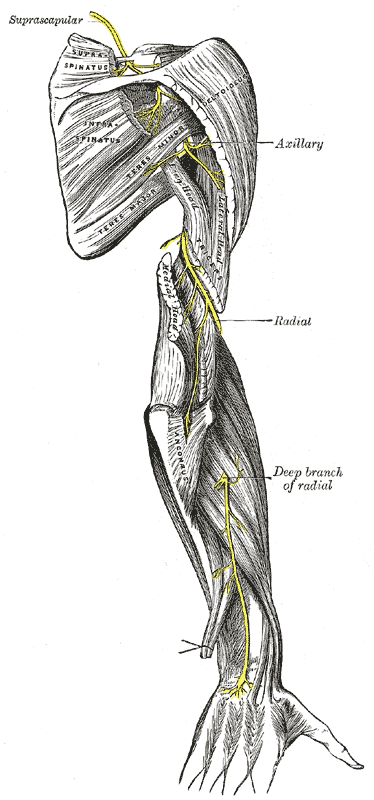
The ulnar nerve courses from the brachial plexus through the arm, passes behind the medial epicondyle at the cubital tunnel, and innervates the intrinsic hand muscles. Source: Gray's Anatomy (1918), public domain
Mechanical Issue in Conventional Typing
Conventional keyboards sustain the postures that provoke cubital tunnel syndrome across the upper extremity chain.
Sustained Elbow Flexion
Standard desk ergonomics hold elbows at 90+ degrees of flexion. At 90 degrees:
- Cubital tunnel volume decreases ~55%
- Intraneural pressure increases 6-fold over extension
- The nerve elongates under longitudinal traction
- Osborne's band tightens into a compressive roof
Forearm Pronation and Unsupported Arms
Full forearm pronation on conventional keyboards:
- Increases ulnar nerve tension around the medial epicondyle
- Engages pronator teres and quadratus continuously
- Raises forearm flexor compartment tone near the cubital tunnel exit
Unsupported arms require proximal muscles to stabilize the limb, adding load at every level.
Proximal Compensation Patterns
Unsupported hands and forearms drive compensatory loading:
- Shoulder elevation: Trapezius and levator scapulae engage, increasing brachial plexus tension
- Wrist extension: Forearm extensors lock the wrist, raising compartment pressure
- Grip-hover cycling: Alternating intrinsic grip and proximal stabilization creates cumulative fatigue across the nerve distribution
Conventional Keyboard
- Elbows flexed 90-120 degrees for hours
- Forearms fully pronated
- Arms unsupported - shoulder and trapezius stabilize
- Wrist extensors engaged continuously
- Ulnar-innervated intrinsics repeatedly loaded
- Intraneural pressure elevated throughout
- No ulnar nerve unloading
Sustained compression + traction, compounded by proximal chain tension
Svalboard
- Elbows at more open angle, palm fully supported
- Forearms in neutral rotation
- Arms fully supported - shoulder and trapezius disengaged
- Wrist neutral - no extensor engagement
- Low activation force reduces intrinsic demand
- Intraneural pressure at baseline
- Continuous postural unloading
Ulnar nerve at rest - low compression, traction, and proximal tension
What Svalboard Changes
The ulnar nerve runs continuously from cervical spine to fingertips. Elbow-only interventions often fail because tension at any point along the nerve increases tension at every other point. Svalboard intervenes at multiple points along the chain simultaneously.
Full Palm Support Reduces Elbow Flexion
Your hand cups into the Svalboard and rests at all times. No hovering, reaching, or repositioning. The elbow can rest at a more open angle. Even a modest reduction - 110 to 80 degrees - drops intraneural pressure substantially.
Neutral Posture Reduces Neural Tension
Forearm in neutral rotation, wrist in neutral, shoulder at rest. The ulnar nerve sits in its slackest configuration. No traction, no cubital tunnel compression, no adverse tension from proximal loading.
Reduced Proximal Stabilization
On a conventional keyboard, trapezius, deltoid, and rotator cuff work continuously to stabilize unsupported arms. This increases brachial plexus tension and adds traction above the elbow. Full arm support removes this load.
Lower Force Reduces Intrinsic Fatigue
When ulnar-innervated intrinsics fatigue, MCP stabilization and fine coordination degrade. Extrinsic muscles compensate, raising forearm compartment pressure and loading the cubital tunnel. Low activation force keeps intrinsic demand well below fatigue threshold.
Cumulative Neural Tension Reduction
Reduced tension at every point along the nerve:
- Cervical spine: Less trapezius engagement, lower brachial plexus tension
- Shoulder: Arm supported, deltoid and rotator cuff unloaded
- Elbow: More open angle, lower intraneural pressure
- Forearm: Neutral rotation, lower compartment pressure
- Wrist/Hand: Neutral posture, low intrinsic demand
Clinical Impact
Svalboard addresses all four mechanistic contributors to cubital tunnel syndrome simultaneously, reducing mechanical burden on the ulnar nerve across its path.
Ulnar Nerve Irritation
Lower intraneural pressure via open elbow angle, neutral rotation, and removal of sustained flexion
Shoulder/Trapezius Compensation
Full arm support drops proximal stabilization demand, removing a major source of adverse neural tension
Cumulative Neural Tension
Slack at cervical, shoulder, elbow, forearm, and wrist produces multiplicative reduction in nerve strain
Elbow Flexion Demand
Palm-supported posture allows a more open elbow angle, reducing compression and longitudinal traction
Clinical Summary: Svalboard reduces ulnar nerve strain by unloading the upper extremity chain. Full palm support, neutral rotation, low activation force, and removal of proximal compensation collectively reduce intraneural pressure, traction, and adverse neural tension across the full nerve length.